
From Earth to Orbit: The New Geography of AI Infrastructure
Artificial intelligence is redefining the scale, location and economics of digital systems. As generative AI, high-performance computing and cloud services accelerate, data centres have become one of the world’s fastest-growing investment priorities. McKinsey estimates that cumulative investment in data-centre infrastructure could amount to $7 trillion by 2030, driven by AI expansion.
Growth depends on access to electricity, grid capacity, cooling technologies and permitting. Analysts indicate that around half of global data-centre capacity expected in 2026 could face deployment delays because of these constraints.
These pressures are leading industry and governments to reconsider where future digital capacity could be deployed. Among the concepts attracting attention, space-based data centres have moved from a theoretical proposition to an area of active experimentation.
Whether orbital facilities ultimately become a specialised capability or a complementary layer of future AI ecosystems, this emerging trend already illustrates how investment priorities are reshaping the geography of computing resources.
AI Is Turning Infrastructure into a Strategic Resource
The interest in space-based data centres reflects the transformation of terrestrial infrastructure. Artificial intelligence is changing the physical requirements of digital services, with complex models demanding higher processing densities, continuous availability and notably greater energy consumption. As AI workloads expand from development phase to large-scale inference, performance depends as much on supporting structures as on advances in semiconductors.
Power is consequently one of the defining variables in data-centre planning. The International Energy Agency (IEA) estimates that global electricity consumption by data centres could more than double by 2030, reaching around 945 TWh, with artificial intelligence representing the main driver of this growth. Electricity demand from AI-optimised data centres alone is expected to more than quadruple over the same period, reflecting the additional requirements for generation capacity and transmission networks.
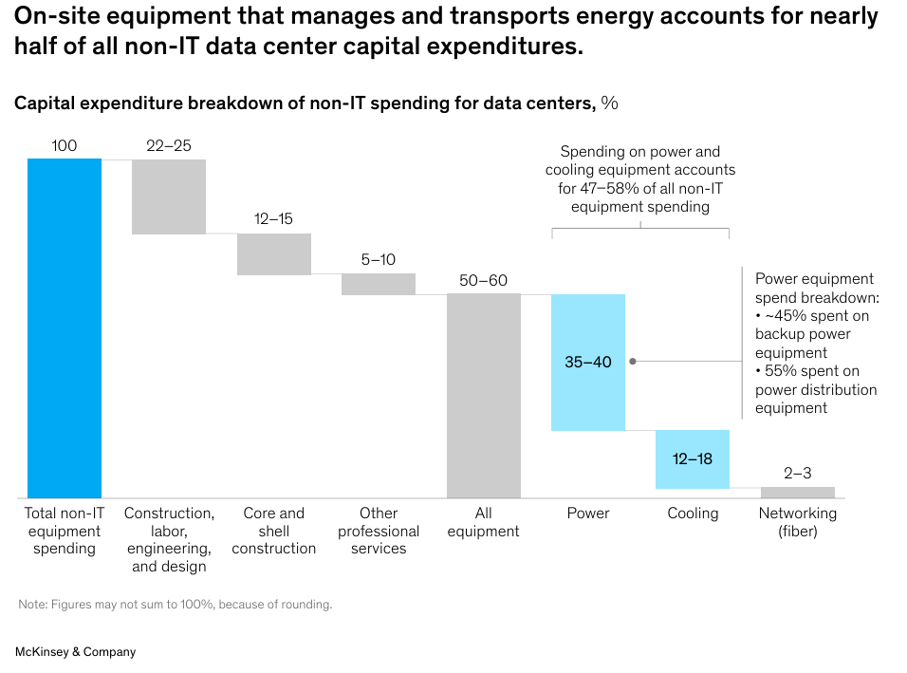
These developments are reshaping the engineering requirements of modern facilities. Higher power densities generate greater heat loads, boosting demand for advanced cooling technologies, water resources and high-capacity electrical systems. According to McKinsey, infrastructure supporting AI data centres, including power distribution, cooling and electrical components, is a major area of capital investment.
Site availability highly determines where computing capacity can be developed. Access to suitable land, reliable electricity networks, water resources and permitting procedures now influence investment decisions as much as digital connectivity. In numerous mature markets, grid connection delays and regulatory scrutiny are affecting large-scale data-centre projects. Several jurisdictions in Europe and the United States are reviewing restrictions or delaying approvals for new data-centre projects as electricity demand continues to accelerate.
These constraints are influencing industrial strategies. Hyperscale operators are moving closer to power generation assets, securing long-term electricity supply and supporting additional generation capacity. Already in 2024, Microsoft announced an agreement with Constellation Energy to support the restart of the Three Mile Island Unit 1 nuclear facility in Pennsylvania, securing access to approximately 835 MW of carbon-free electricity through a long-term power purchase agreement. In 2025, Google announced the deployment of its first advanced nuclear reactor project with Kairos Power and the Tennessee Valley Authority, targeting an initial 50 MW supply by 2030 as part of a broader programme aiming to develop up to 500 MW of advanced nuclear capacity.
The search for power has therefore evolved into a search for comprehensive ecosystems capable of delivering reliable energy, resilient networks and long-term scalability. Within this context, the question is shifting from how data centres are built to where future computing capacity can be sustainably deployed.
Orbit Is an Industrial Hypothesis
The constraints shaping terrestrial data-centre development are leading governments, technology companies and space operators to explore whether part of future capacity could eventually be deployed in orbit. Space-based data centres are being seen as a potential complement to terrestrial facilities, particularly for applications requiring constant computing power, satellite data processing and high-availability digital services.
Several engineering characteristics explain this interest:
- Continuous access to solar energy, offering the potential to reduce dependence on terrestrial electricity networks and grid constraints.
- Radiative cooling through the vacuum of space, which could support heat dissipation, although thermal management is a major challenge for high-performance operations in orbit.
- Proximity to satellite constellations and Earth observation systems, enabling selected datasets to be processed directly in orbit rather than transmitted back to Earth.
- Reduced latency for specific applications, where data generation, processing and distribution occur within the same orbital environment.
- Sovereign digital capabilities, supporting applications requiring secure and geographically diversified infrastructure.
Orbital computing also raises strategic questions around digital sovereignty and security. Governments are expanding investment in secure communications, Earth observation and space-based services supporting extensive assets, creating interest in in-orbit capabilities for defence, environmental monitoring and strategic industrial applications.
McKinsey recently explored this field through an interview with Philip Johnston, Founder and CEO of Starcloud. Johnston argues that declining launch costs, driven by reusable launch systems, combined with accelerating AI demand, could justify greater consideration of orbital data centres. He highlights continuous solar energy and the possibility of expanding power generation in orbit as potential advantages, while recognising that economic viability, thermal management and deployment scale are decisive challenges.
An Entire Orbital Computing Ecosystem Takes Shape
A relatively small group of companies, public institutions and technology organisations is translating this vision into concrete projects, through demonstration missions, feasibility studies and strategic investment.
Among the most relevant initiatives are:
- Starcloud (United States) – One of the leading companies dedicated exclusively to orbital AI data centres. In November 2025, the company launched Starcloud-1, a demonstration satellite equipped with an NVIDIA H100 GPU. The mission demonstrated AI computing capabilities in orbit, including running Google’s Gemma model and training a small language model directly onboard the spacecraft. Starcloud aims to develop larger orbital platforms powered by solar energy.
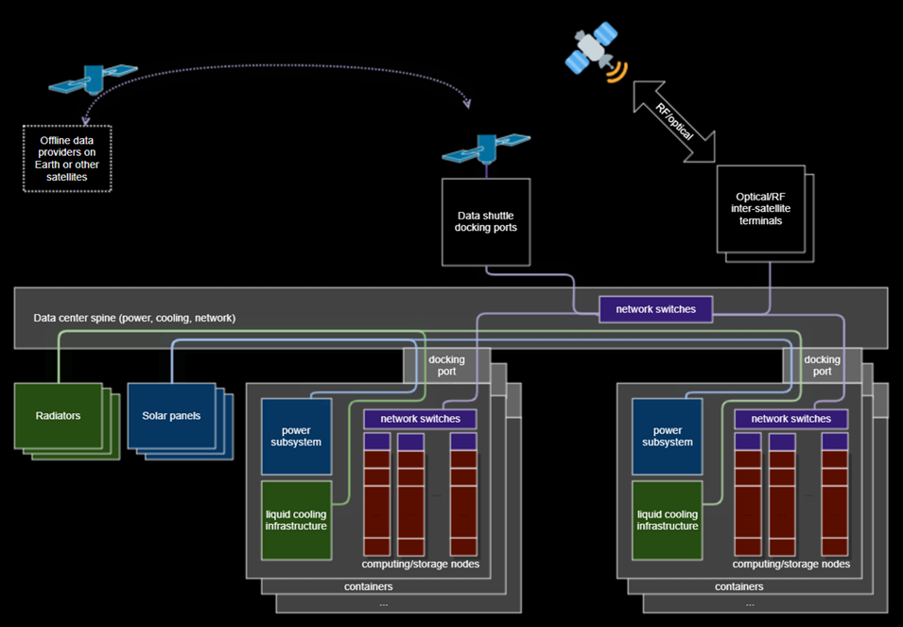
- Lonestar Space (United States) – Developing StarVault, a sovereign space-based data platform providing secure data storage and AI inference services for governments, critical infrastructure operators and enterprise customers. Its roadmap extends from Earth orbits towards the Earth–Moon system, illustrating how specialised services could become one of the first commercial applications of space-based computing.
- European Space Agency (ESA) – ESA has been evaluating the feasibility of space-based data centres through research initiatives involving industrial partners such as IBM and KP Labs. These studies explore how future orbital solutions could process space-generated data closer to its source and reduce reliance on terrestrial data transmission.
- Chinese companies – China is developing one of the most ambitious orbital computing programmes through Guoxing Aerospace (ADA Space) and research partners including Zhejiang Lab. Following the launch of its first computing satellites in 2025, the programme has demonstrated AI processing directly in orbit, including the deployment of Alibaba’s Qwen3 large language model. This approach explores distributed architectures combining satellites, onboard processors and communication networks.
- SpaceX – Although not developing orbital data centres itself, SpaceX is one of the principal enablers of the sector. Its Starship programme aims to provide fully reusable heavy-lift launch capabilities that could clearly reduce the cost of deploying and maintaining large-scale orbital installations.
These initiatives illustrate the diversity of strategies currently shaping the orbital data-centre landscape, from dedicated AI platforms and sovereign data services to distributed satellite-based architectures. The development of these systems will ultimately depend on the ability to transform technical demonstrations into economically sustainable models. Launch costs, power generation, thermal management and the selection of appropriate workloads will determine where space-based computing can create value compared with terrestrial alternatives. The key question is therefore which applications can justify the deployment of this new paradigm and the capital required to support it.
CAPEX Redefines the Infrastructure Landscape
If orbital data centres move towards commercial deployment, capital expenditure will follow a different logic from that of conventional facilities. Instead of concentrating investment on land, buildings and electrical systems, future projects will depend on the integration of multiple space and digital technologies.
Investment priorities are likely to include:
- Launch systems, to reduce deployment costs and support large-scale orbital initiatives.
- Space-qualified semiconductors, capable of sustaining high-performance processing under radiation exposure.
- Thermal management, enabling reliable heat dissipation for high-density workloads.
- Solar power generation, providing continuous energy for orbital operations.
- Optical and laser communications, ensuring high-capacity data transmission between space and Earth.
- Robotics and autonomous servicing, supporting inspection, maintenance and long-term operation.
- Software orchestration, coordinating computing resources across orbital and terrestrial domains.
- Ground stations and operational networks, linking orbital platforms with terrestrial networks.
These priorities illustrate a significant evolution in CAPEX strategy. Investment would shift from the construction of individual data centres towards the development of an integrated industrial ecosystem combining aerospace, energy, semiconductors, communications and software.
INCONCRETO’s Value Proposal: Navigating the Next Wave of Industrial Investment
Orbital computing may ultimately remain a specialised capability or become an integral component of future digital ecosystems. Whatever its trajectory, it provides a valuable insight into how industrial investment is evolving.
Across sectors, competitive advantage increasingly depends on the ability to anticipate which technologies are reaching industrial maturity and how these shifts will influence future capital allocation.
INCONCRETO works with organisations to translate emerging technology trends into industrial strategy. From evaluating emerging models to assessing their implications for operations, supply chains and investment planning, the objective is to transform technological uncertainty into informed decision-making. Understanding how industrial ecosystems are evolving is becoming as important as understanding the technologies that enable them.
For further reading, you may consult these sources:
- The $7 trillion data center build-out: How industrials can capture their share, by McKinsey & Co.
- Colocation data centers: The infrastructure race behind AI, by McKinsey & Co.
- Energy and AI, by The International Energy Agency (IEA)
- Beyond compute: Infrastructure that powers and cools AI data centers, by McKinsey & Co.
- Where are authorities restricting data centres amid AI boom?, by Reuters
- The case for data centers in space, by McKinsey & Co.
- Why we should train AI in space, White Paper by Starcloud
- Knowledge beyond our planet: space-based data centres, by The European Space Agency (ESA)
Latest News












© INCONCRETO. All rights reserved. Powered by AYM