
When Biology Leaves Earth: The Industrial Potential of Microgravity
Space is becoming a new environment for scientific research, commercial activity and industrial experimentation, and biotechnology is emerging as one of the fields where its distinctive conditions could translate into tangible value on Earth. The convergence of the two is attracting growing attention across healthcare, agriculture and advanced biological research, as the World Economic Forum recently highlighted in its analysis of how space-based experimentation could contribute to new applications for life on our planet.
For most of modern biotechnology, gravity is part of the equation. Cells settle, fluids circulate, proteins crystallise and tissues develop under its influence. In microgravity, these interactions change, creating conditions in which certain biological processes can behave differently from their terrestrial counterparts.
These effects are being explored across pharmaceuticals, regenerative medicine, tissue engineering and advanced biomaterials, where even small changes can carry significant scientific or commercial value. Companies, research institutions and space agencies are developing the technologies and services needed to turn these findings into repeatable applications, linking orbital research with manufacturing and processing on Earth.
A Laboratory Without Gravity
Microgravity alters biological processes in ways that can be useful for specific applications. Reduced sedimentation and convection, together with changes in fluid behaviour and mechanical forces, can affect how proteins crystallise, how cells organise and how tissues develop. The value of these effects depends on the biological process involved and on whether they translate into a meaningful improvement for research or production.
Protein crystallisation is among the most established examples. Under terrestrial conditions, gravity can influence fluid flows and particle movement, affecting the formation of highly ordered protein crystals. In orbit, the reduced influence of these forces can support the formation of larger and more uniform structures, providing researchers with a different route to studying the architecture of complex proteins.
The International Space Station National Laboratory has documented pharmaceutical research using microgravity-grown crystals for drug development. Merck, for instance, investigated the crystallisation of Keytruda, its protein-based cancer treatment, in orbit, with the objective of improving understanding of the drug’s structure and potential formulation and manufacturing benefits.
The same effects are being studied in living systems, where microgravity can influence cell organisation, tissue formation and ageing-related mechanisms. Research is now moving towards applications in therapies, biological materials and manufacturing processes, particularly where these altered conditions could deliver a measurable advantage.
Where Space can add Biological Value
Healthcare is already a major focus of this research.
On the International Space Station, NASA is testing a newly developed microgravity bioreactor designed to produce large quantities of blood stem cells for pharmaceutical and clinical use. The research addresses a limitation of terrestrial production: during expansion, stem cells can lose some of their ability to generate the red and white blood cells and platelets needed by patients treated for blood cancers and other serious diseases. Tests are analysing whether microgravity can help preserve stem-cell quality while enabling larger-scale production. The samples will then be frozen and returned to Earth for further analysis, connecting orbital production directly to potential medical applications.
A separate investigation has involved 3D bioprinting cartilage tissue aboard the ISS. The objective is to understand whether microgravity can support the production of human tissue for regenerative medicine and, ultimately, personalised implants.
The same approach is being explored in disease modelling and personalised medicine. European Space Agency (ESA)’s M4PM initiative, Microgravity for Personalized Medicine, is investigating the growth of tumours, organoids and spheroids under low-shear conditions in space, with the aim of developing applications for personalised medicine.
The potential applications extend further into biomaterials, food and nutrition. ESA’s current work on bioengineering in the space environment explicitly examines pharmaceuticals, healthcare, materials science, food and nutrients, while asking industry to assess customer demand and develop commercially viable business propositions.
These applications share a crucial economic characteristic: high value relative to physical mass. With launch and return costs still significant, orbital manufacturing favours specialised pharmaceuticals, biological materials and advanced tissue models, where a small amount of orbital processing could deliver substantial gains in performance, knowledge or commercial value.
The First Market may be the Laboratory
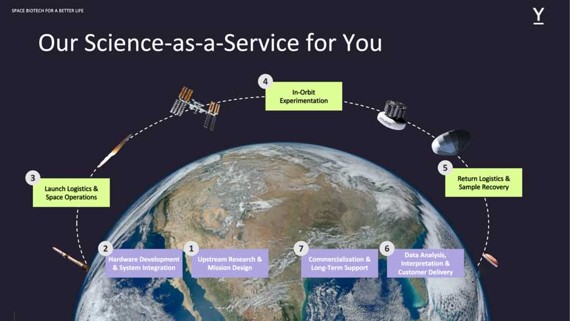
Orbital laboratories, automated bioreactors and reliable return services could give companies access to microgravity without requiring ownership of an orbital factory. Several European initiatives are already developing this integrated service model.
ESA’s AURORA feasibility study, led by Yuri GmbH and supported by ATMOS Space Cargo, is assessing the commercial viability of bioengineering in microgravity across pharmaceuticals, healthcare, food and nutrition. The project focuses on tissue models, organoids and biomaterials, understanding whether microgravity can deliver measurable gains in quality, scalability or cost. Yuri’s automated laboratory and ATMOS’s PHOENIX return capsule provide an end-to-end service from launch and experimentation to sample recovery.
Another ESA-supported initiative, RSAS, led by ALATYR, takes an even more explicit service perspective. It is testing application workflows on the ground first, using simulated microgravity to identify which processes justify later orbital demonstrations. Its target users include pharmaceutical and biotechnology companies working on organoids, tumoroids, drug screening, ageing-related models and sequencing.
The commercial logic is becoming increasingly clear: companies can test processes on Earth, reproduce microgravity conditions on the ground and send only the most promising applications into orbit for production, analysis or further processing. An early market could therefore centre on access to orbital biological research and production as a service.
The Product has to come Home
Biological production in orbit will depend on reliable return logistics. Samples may require controlled recovery and preservation before analysis or further processing on Earth, making the return journey an integral part of the production chain. This is driving demand for dedicated cargo-return systems capable of transporting biological material safely and predictably from orbit to terrestrial laboratories and manufacturing facilities.
In September 2026, ESA awarded The Exploration Company a €760 million contract for the next phase of ALADDIN, its European commercial cargo-return programme. The project aims to develop autonomous transportation to and from low Earth orbit, with an initial demonstration mission followed by optional service missions.
Private operators are moving in the same direction. Space Cargo, based in Luxembourg, has signed an agreement to use SpaceX’s Starfall system for a planned 2028 mission. Its BentoBox system is designed to carry multiple payloads through a microgravity mission and return them to Earth. Almost half of Space Cargo’s potential customers for its first Starfall mission is expected to be in life sciences and biotechnology.
The emergence of dedicated return capacity could materially affect the economics of the sector. Researchers can begin to think in terms of repeatable production cycles, rather than isolated experiments attached to individual space missions.
Building the Industrial Foundations of Orbital Biology
Moving from individual experiments to repeatable production requires integrated capabilities across the orbital and terrestrial sides of the value chain. Bioreactors, remote monitoring, robotics and sensing must operate reliably with limited human intervention, while power, thermal management, contamination control and downstream terrestrial processing have to function as part of the same production chain. Reliable power, thermal management and contamination control are crucial, as is the terrestrial infrastructure required to recover, analyse and further process the material after return. The industrial challenge therefore extends across the entire production chain, from biological processing in orbit to downstream manufacturing on Earth.
A biological product created in orbit may still require purification, formulation, testing, regulatory approval and distribution on Earth. The future industrial system is consequently likely to combine orbital and terrestrial operations, with each location performing the steps for which it offers the greatest advantage.
This is already influencing the way European projects are being designed: as an example, ESA’s MAST is assessing the commercial and technical viability of an automated, high-throughput biological research platform on commercial space stations in low Earth orbit. The objective is to establish which services customers would actually buy, how frequently they would use them and what technical configuration could deliver those services at a viable cost.
The Economics of Biological Production in Orbit
The economic case for biological production in orbit will depend on some specific variables:
- Value density: how much commercial value can be generated from a limited mass.
- Microgravity advantage: the measurable improvement in quality, performance, yield or research capability compared with terrestrial conditions.
- Process duration: how long the biological process needs to remain in orbit.
- Utilisation: how efficiently orbital laboratory capacity can be used across different customers and applications.
- Automation: the level of robotics, monitoring and remote operation required.
- Access costs: launch, orbital operations and return to Earth.
- Terrestrial integration: which stages of the value chain can remain on the ground.
- Commercialisation: the regulatory and validation requirements before an application can reach the market.
INCONCRETO’s Value Proposal: From Scientific Potential to Industrial Strategy
Space biotechnology brings together pharmaceuticals, healthcare, advanced materials, aerospace, automation and logistics, creating opportunities across established value chains.
For companies operating in these fields, the strategic task is to identify where microgravity can generate measurable value, what capabilities are required, and how orbital and terrestrial activities should connect.
INCONCRETO helps organisations assess these opportunities across technology readiness, industrial capabilities, partnerships, supply chains, business models and capital requirements.
The opportunities with the strongest industrial rationale will be those where microgravity generates sufficient value to justify its place in the biological value chain.
For further reading, you may consult these sources:
- As space and biotechnology research converge, here’s how it affects life on Earth, by World Economic Forum.
- Biomanufacturing in low Earth orbit for regenerative medicine, on the National Library of Medicine
- Life Sciences Biotech & Pharma, by ESA
- Health innovation trends and opportunities for space businesses, by ESA
- Growing Stem Cells in Space to Improve Cancer and Disease Treatments, by NASA
- Building a Robust Commercial Microgravity Economy in Earth’s Orbit: Economic Readiness Considerations, by NASA
- Technical and regulatory opportunities and challenges for cell and gene therapies in low earth orbit: a status report, on the National Library of Medicine
Latest News











© INCONCRETO. All rights reserved. Powered by AYM